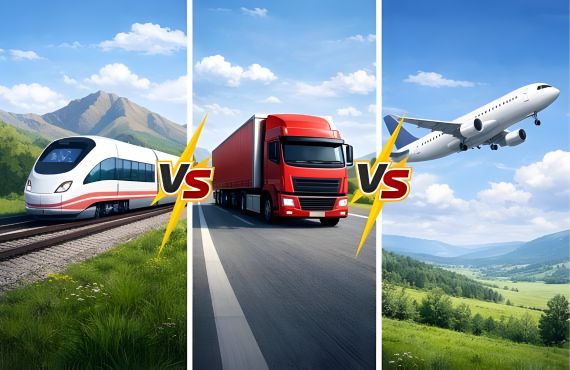
Choosing the right freight transport mode is one of the most important logistics decisions for any business. The method you select directly impacts delivery time, cost, cargo safety, and overall supply chain efficiency. Rail, road, and air freight each offer unique advantages depending on shipment size, urgency, distance, and budget.
This guide will help you understand the differences and decide which transport mode is best suited for your cargo.
1. Rail Freight
Rail freight is one of the most economical and reliable options for transporting bulk goods over long distances.
Key Advantages
-
Cost-effective for heavy cargo
Ideal for bulk shipments such as industrial goods, raw materials, and large consignments.
-
High load capacity
Trains can handle significantly larger volumes compared to trucks or aircraft.
-
Reliable transit schedules
Rail networks operate on fixed timetables, reducing uncertainty.
-
Eco-friendly
Lower carbon emissions per ton transported.
Best Suited For
- Bulk cargo
- Long-distance domestic transport
- Non-urgent shipments
- Industrial and infrastructure materials
Limitations
- Limited last-mile delivery
- Requires road transport for pickup and final delivery
- Slower than air freight
2. Road Freight
Road freight is the most flexible and widely used transport mode, offering door-to-door delivery across cities, towns, and remote areas.
Key Advantages
-
Door-to-door service
Direct pickup and delivery without modal transfers.
-
Flexible routing
Trucks can reach rural and hard-to-access locations.
-
Suitable for all shipment sizes
From small parcels (PTL/LTL) to full truck loads (FTL).
-
Faster for short to medium distances
Best Suited For
- FMCG goods
- Retail shipments
- E-commerce deliveries
- Regional distribution
- Time-sensitive mid-range cargo
Limitations
- Higher cost than rail for bulk loads
- Traffic and weather delays
- Limited load capacity vs rail
3. Air Freight
Air freight is the fastest transport solution, designed for urgent and high-value shipments.
Key Advantages
-
Fastest delivery mode
Ideal for emergency or time-critical cargo.
-
High security
Strict airport handling and monitoring.
-
Global connectivity
Domestic and international reach.
-
Reduced damage risk
Minimal handling and shorter transit time.
Best Suited For
- Pharmaceuticals
- Electronics
- Medical supplies
- Perishable goods
- Urgent documents & spare parts
Limitations
- Most expensive option
- Weight and size restrictions
- Weather and flight schedule dependency
How to Choose the Best Mode?
Consider these factors before selecting transport:
1. Urgency
- Immediate delivery → Air
- Moderate timeline → Road
- Flexible timeline → Rail
2. Shipment Size
- Heavy/Bulk → Rail
- Medium → Road
- Lightweight/High value → Air
3. Budget
- Lowest cost → Rail
- Balanced cost → Road
- Premium cost → Air
4. Delivery Location
- Remote / door delivery → Road
- Metro to metro bulk → Rail
- International / urgent → Air
Multi-Modal Logistics: The Smart Approach
Many businesses now combine transport modes for maximum efficiency:
This integrated model balances speed, cost, and reach.
Conclusion
There is no single “best” freight mode — the right choice depends on your cargo type, timeline, and budget.
-
Choose Rail for economical bulk transport
-
Choose Road for flexibility and door delivery
-
Choose Air for speed and urgent shipments
A strategic logistics partner can help you select or combine modes to create the most efficient shipping solution for your business.